
Rule of Thumb Before You Start
Most garage door noise is loose hardware or dry metal, and tightening bolts plus lubricating moving parts fixes it in under an hour. The exceptions are loud pops, grinding, or a door that sounds like it's grinding metal-on-metal when it moves — those usually point to a worn spring, a bad bearing, or a track problem, and they're not a DIY fix. If your door also looks crooked, hangs unevenly, or has jumped its track, stop using the opener and call a technician before you touch anything else.
Tools You'll Need for the DIY Steps
- Socket wrench or ratchet set
- Silicone-based garage door lubricant (not WD-40 or household oil — those attract dust and grit)
- Sturdy step ladder
- Flashlight
- Work gloves
- Rubber isolation pads (sold for garage door openers, optional but helpful)
Step-by-Step: Quieting the Opener Yourself
- Listen first and note the pattern. Does it squeal only on the way up, bang at the very end of travel, or rattle the whole time? A hum with no movement often means a stuck limit switch or a capacitor issue inside the motor — that's technician territory, not a lubrication fix.
- Tighten every bolt and bracket. With the door closed and the opener unplugged, go along the track brackets, the header bracket, and the motor mount with your socket wrench. Vibration loosens these over time, and in homes here the constant cycle of humidity swelling and dry heat shrinking wood framing speeds that loosening up.
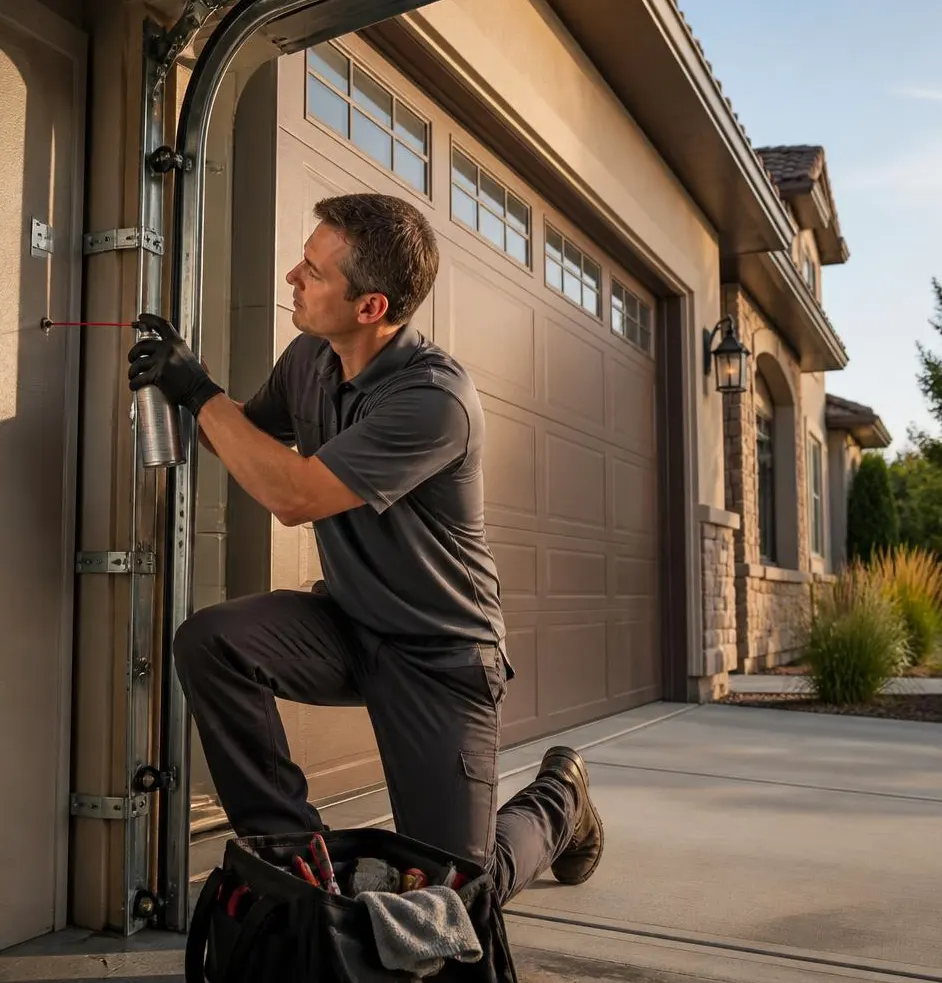
- Lubricate the moving metal parts. Spray silicone lubricant on the rollers, hinges, springs, and the opener's drive chain or screw rail. Wipe off excess so it doesn't drip onto the floor or attract dust. Do this every few months rather than once a year — the humidity swings common to this area work lubricant out of joints faster than in drier climates.
- Inspect the rollers. Cracked, flat-spotted, or chipped rollers are a common noise source. Plastic rollers are the loudest and cheapest to replace; nylon rollers with sealed bearings run quieter and hold up better against moisture. Swapping worn rollers is a reasonable DIY job if you're comfortable working with the door's tension released and the panel supported.
- Check chain or belt tension on the opener. A chain that's too loose will slap against the rail with every cycle. Most openers have an adjustment nut near the motor head; consult your owner's manual for the right amount of sag (usually a small, specific gap, not fully taut).
- Add isolation pads at the motor mount. Rubber pads between the opener bracket and the ceiling joist absorb vibration so it doesn't transmit into the attic or living space above the garage — a quick fix that makes a noticeable difference for openers mounted near bedrooms.
- Check weatherstripping and seals. Swollen bottom seals or side weatherstripping, common after a stretch of humid weather or heavy rain, can rub against the frame and sound like a grinding or scraping noise that has nothing to do with the hardware at all.
Where DIY Stops and a Technician Should Take Over
- Loud bangs or pops, especially near the top of the door. This is often a spring under extreme tension losing its grip or starting to fail — springs store enough force to cause serious injury and should only be handled by a trained technician.
- Grinding that doesn't go away after lubrication. This usually means a worn bearing plate, a bent track, or a cable starting to fray.
- A door that's visibly off track or binding on one side. Afternoon downpours and wind gusts during storm season can nudge tracks out of alignment even on doors rated for wind load, and forcing a misaligned door with the opener can damage the motor.
- Rust on the chain, hinges, or track. Salt air and humidity accelerate rust on hardware, and a rusted chain or track isn't something lubricant alone will fix long-term.
The Bigger Fix: Swapping to a Belt-Drive Opener
If you've done all the maintenance steps above and the opener is still noisy, the drive mechanism itself may be the problem. Chain-drive openers are inherently louder because they move the door with metal links running over a sprocket. Belt-drive openers use a reinforced rubber or polyurethane belt instead, which runs noticeably quieter and holds up well against the moisture swings common here since there's no metal chain to rust or stretch.
A belt-drive swap usually means replacing the entire opener unit, not just the rail. This involves disconnecting and remounting the motor head, rewiring safety sensors, setting travel limits, and programming remotes and keypads — all best left to a technician, both for safety and to make sure the force settings and auto-reverse sensors are calibrated correctly. National pricing for a full opener replacement with installation typically runs in the low-to-mid hundreds of dollars range depending on horsepower and features, though your exact cost will depend on the unit chosen and site conditions.
When to Call Goldenrod Door & Opener
If you've tightened hardware, lubricated everything, and the door is still noisy — or if you're hearing grinding, popping, or seeing visible wear on springs, cables, or track — it's time to call in a professional. Our team handles Garage Door Tune-Up & Maintenance visits to catch roller, bearing, and hardware wear before it turns into a bigger repair, and we install quiet belt-drive openers for homeowners ready to retire a clattering chain-drive unit for good. We'll also check your springs, cables, and track alignment while we're there, since noise is often the first sign something else needs attention.
Ready for a quieter garage door? Call Goldenrod Door & Opener today — proudly serving Goldenrod, FL and nearby Winter Park, Casselberry, Maitland, Altamonte Springs, Oviedo, Orlando, and Winter Springs.